Article: Peptides vs. Collagen Supplements: What Actually Firms Skin

Peptides vs. Collagen Supplements: What Actually Firms Skin
Oral collagen and topical peptides both have real evidence behind them, but they work through different mechanisms. Oral collagen is digested and distributed through the body. Topical peptides act locally, signaling skin cells exactly where they are applied. They are not competing claims. They address firmness from two different directions.
What the Research Actually Shows About Oral Collagen
Collagen is a large protein, and the body cannot absorb it intact. Digestion breaks it down into amino acids and smaller peptide fragments before it reaches the bloodstream. For years, this raised real doubt about whether oral collagen could do anything for skin specifically.
The research since has been more encouraging than that doubt suggested. Studies tracking collagen-derived peptides after ingestion have found they reach measurable concentrations in the bloodstream within one to two hours. More importantly, a randomized, double-blind, placebo-controlled trial found that twelve weeks of oral collagen peptide supplementation produced measurable improvements in skin hydration, elasticity, and dermal structure, effects that continued even after supplementation stopped. This does not mean every collagen product on the market is formulated well enough to replicate those results. It does mean the underlying premise, that what you ingest can influence skin from the inside, has real support behind it.
How Topical Peptides Work Differently
Topical peptides do not travel through digestion at all. Applied directly to skin, they act as local signals, communicating with skin cells at the specific area where they are pressed in. This is why formulation matters so much for topical peptides: each one is chosen for a specific zone and a specific signal, not a general, body-wide effect. If you want more on how that works on skin over 35, we covered it in Powerhouse Peptides.
This is also why a peptide cream for sagging or loss of firmness works on a different timeline and through a different pathway than an oral supplement. It is not reaching the skin through the bloodstream. It is reaching the skin directly, at the surface, exactly where it is applied.
Why Many Routines Use Both
Because the two work through different pathways, using both is not redundant. Oral collagen supports the body's collagen-building processes broadly. A topical peptide serum or cream targets specific zones directly, at the surface, with a formula built around what each peptide does in that exact area. Neither replaces the other. They are addressing the same concern, firmness, from two different directions.
The timelines differ too, which is worth knowing before you judge either one. Oral studies typically measure change at eight and twelve weeks. Topical peptide evaluations tend to look at eight weeks. Neither works on a schedule you can see in a fortnight, and both depend far more on daily consistency than on the amount used in any single application.
What to Look For in a Peptide Cream for Sagging Skin
Not all peptide formulas are built the same way. A few things separate a formula built with intention from one built around a trending ingredient list.
- Multiple peptides, each with a defined role. A single peptide doing one job is limited. A complex where each peptide targets a specific mechanism, expression, structure, surface refinement, works on more than one level at once.
- Zone-specific targeting. Skin does not sag or lose structure uniformly. A formula that accounts for how different areas, the eye area, the jawline, the forehead, actually change is doing more than a generic anti-aging claim.
- Consistency built into the formula's design. Peptides work cumulatively. A formula meant to be pressed into skin daily, not occasionally, reflects an understanding of how peptides actually perform over time.
- A serum-then-cream layering system. Treatment and protection are different jobs. A lightweight serum that delivers the active peptides, followed by a cream that seals and supports the skin barrier, gives the formula the best conditions to work.
How the Plump & Firm System Applies This
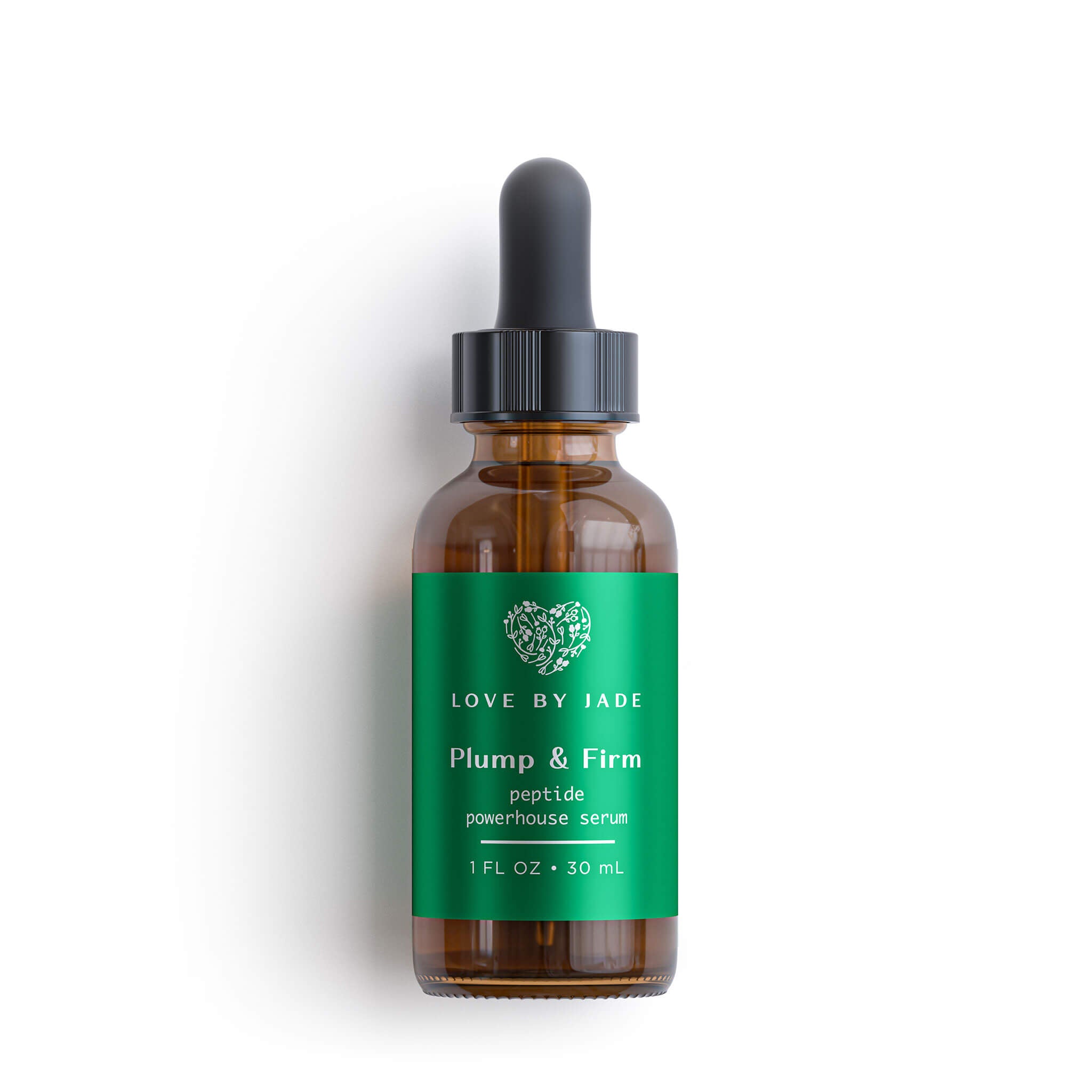
The Plump & Firm Powerhouse Multi-Peptide Serum builds its complex from six peptides, each assigned to a different zone. Argireline and Acetyl Octapeptide-3 target the eye, upper cheek, and forehead, helping visibly soften the look of expression lines with consistent use. Leuphasyl focuses on the brow and inner forehead. SYN-AKE targets the outer eye corner. Matrixyl 3000 supports the lower cheek and jawline, helping the skin's own renewal process where structure tends to soften first. A red seaweed extract, Chondrus Crispus, conditions the skin barrier so the rest of the complex can absorb and perform.
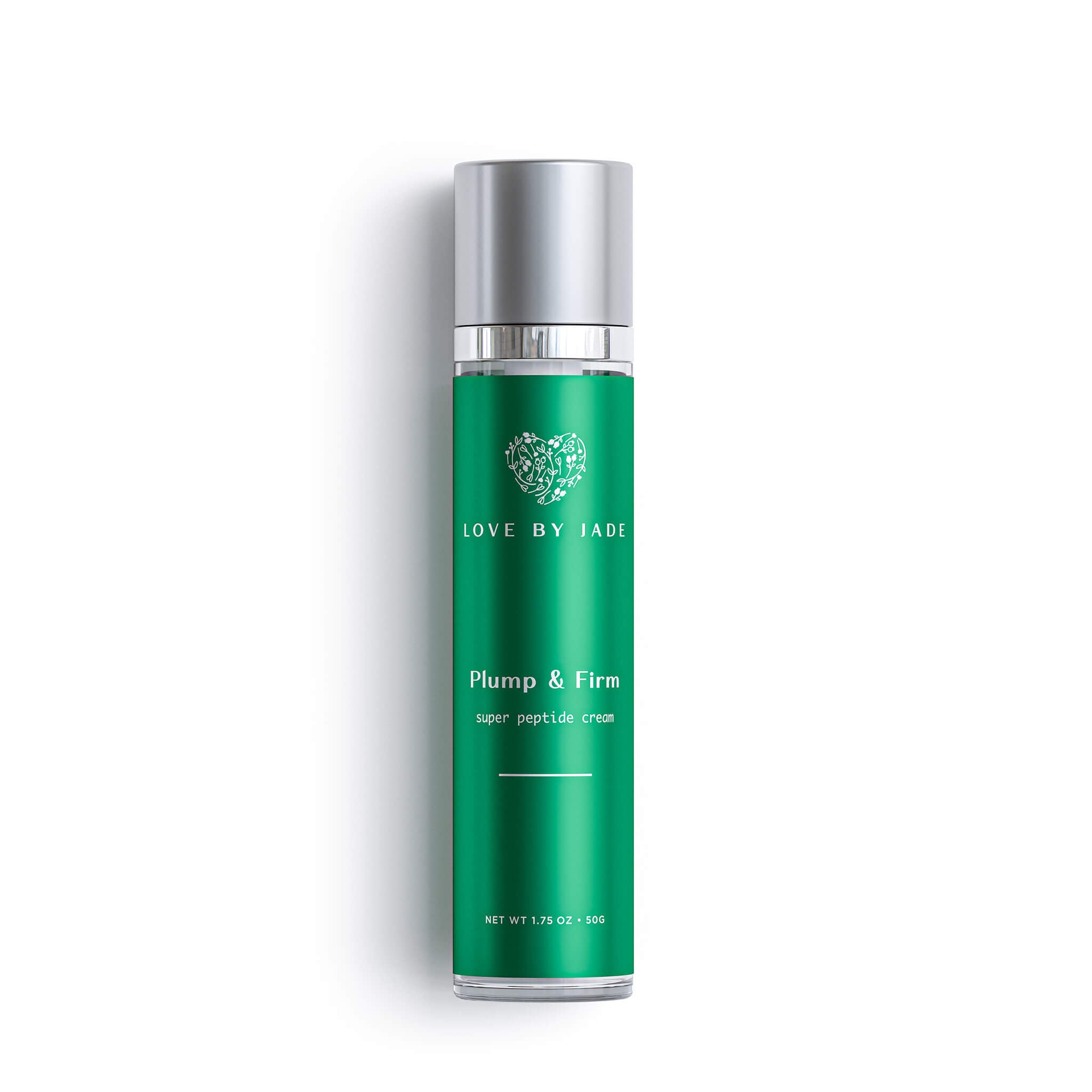
The Plump & Firm Super Peptide Cream follows the serum, sealing in the treatment with resveratrol, hyaluronic acid, squalane, and jojoba, a protective and nourishing layer that supports the skin barrier through the day and night.
Jade ran an 8-week consumer evaluation with thirty women on this formula before it became part of the line. What she saw in their skin, and what they told her about how they felt in the mirror, is why the system exists in its current form. Consistency is everything. Apply it every day, press it in, and give it time. The results are in the ritual.