Why Most Vitamin C Serums Don't Actually Work
A Vitamin C serum works when the concentration is high enough to matter, typically around 15 percent, and when it is stabilized against oxidation. Left unstabilized, Vitamin C degrades quickly once exposed to air, light, and heat, which is why so many Vitamin C serums lose potency before they ever visibly change skin.
Why Most Vitamin C Serums Don't Actually Work
Vitamin C is one of the most studied actives in skincare. It is also one of the most poorly formulated. Ascorbic acid, the purest and most effective form of Vitamin C, is notoriously unstable. Exposed to air, light, or heat without the right supporting actives, it oxidizes, and an oxidized formula has already lost most of what made it worth buying.
Many Vitamin C serums use a concentration too low to matter, chosen for shelf stability and cost rather than results. Others use an effective concentration with no stabilizer, which means the formula starts degrading from the moment the bottle is opened. Either way, the label promises brightening and protection the formula was never positioned to deliver.
What Actually Makes a Vitamin C Serum Work
Two things determine whether a Vitamin C serum performs: concentration and stability.
Concentration. Research consistently points to around 15 percent L-ascorbic acid as the range where meaningful results begin. Below that threshold, the effect on skin tone and antioxidant protection is limited.
Stability. A landmark study out of Duke University found that combining 15 percent L-ascorbic acid with 1 percent alpha-tocopherol (Vitamin E) and 0.5 percent ferulic acid improved the chemical stability of the vitamins and doubled the formula's photoprotective effect on skin, compared to the vitamins alone. Ferulic acid is what makes the difference. It is a plant-derived antioxidant that stabilizes both Vitamin C and Vitamin E, slowing the oxidation process that would otherwise start degrading the formula immediately. A follow-up clinical study confirmed the same combination provided measurable protection for skin against UV-induced damage. This is not a new or trendy pairing. It is one of the most well-documented combinations in dermatology, and it is also one of the least commonly formulated correctly.
How to Tell If Your Vitamin C Serum Has Gone Bad
Ascorbic acid at active concentration has a natural pale yellow tint. That is normal and does not affect performance. If the formula shifts to a deep amber, orange, or brown color, that is a visible sign of oxidation, and the serum has lost much of its potency.
Storage affects how long a formula stays stable. Keep Vitamin C serums away from direct sunlight and heat, and close the bottle immediately after each use. A cool, dark cabinet extends potency considerably longer than a sunlit bathroom shelf.
How the Super CBE & Ferulic Applies This
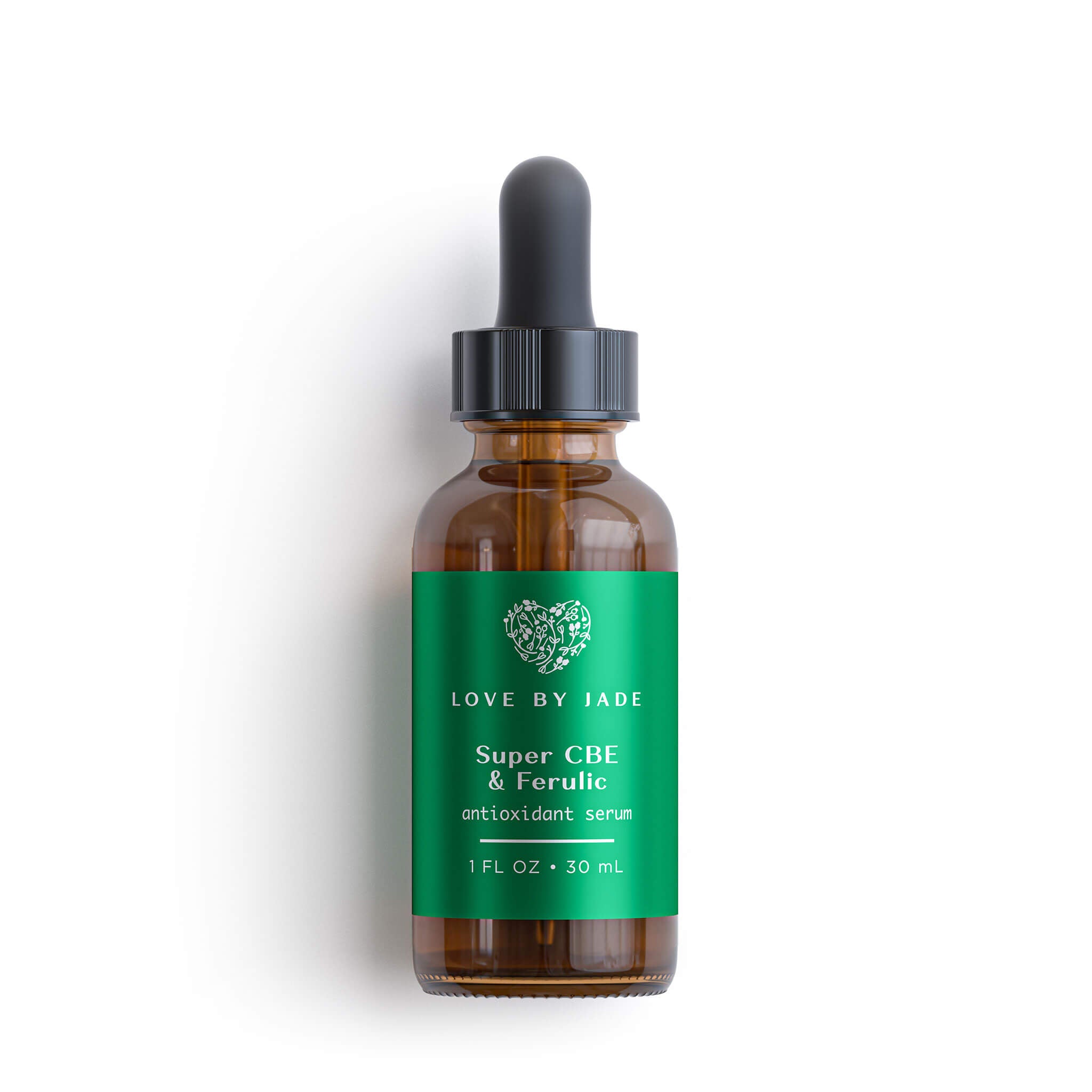
The Super CBE & Ferulic Antioxidant Serum is formulated at exactly the ratio the research supports: 15 percent Vitamin C, 1 percent Vitamin E, and 0.5 percent Ferulic Acid, with Niacinamide added to support an even skin tone and strengthen the skin barrier. Nothing in the ratio is approximate.
It is designed to be the first active step in the morning, applied to damp skin before any other serum, allowed to absorb, then layered under the rest of the routine and finished with SPF. As a daytime antioxidant, it works alongside sun protection rather than in place of it.
Jade was precise about this formula on purpose. The concentration matters. The supporting actives matter. The stability of the formula matters. A Vitamin C serum that cannot hold its own potency was never going to hold up on skin either. The same principle governs botanical oils, where processing decides how much survives into the bottle.